Google doesn’t set a minimum number of reviews, but it does say that more reviews and positive ratings can help your business’s local ranking, according to Google Business Profile Help on local ranking. So if you’re asking “how many Google reviews do I need?”, start with 20. That’s the line where customers start trusting you: 47% of consumers won’t use a business with fewer than 20 reviews, according to BrightLocal’s Local Consumer Review Survey 2026. After that, match or beat the top three businesses in your category nearby, and keep new reviews coming every month.
This guide covers what Google actually says about reviews, what customers expect, how to set your own target, what a healthy pace looks like for three local businesses Around29 Digital Media Solutions works with, and the rules that keep your reviews from being removed.
Does Google have a minimum number of reviews?
No. Google says local results are mainly based on relevance, distance and popularity, and that more reviews and positive ratings can help, but it doesn’t publish a number to hit.
Reviews sit inside what Google calls prominence, meaning how well-known a business is. Google says prominence is “based on info like how many websites link to your business and how many reviews you have.” So reviews are one input among several, next to how well your profile matches the search and how close you are to the person searching.
That’s why a business with fewer reviews can still outrank you if it’s closer to the customer or a better match for what they typed. Reviews won’t fix a Business Profile with the wrong categories or missing services. The Google Business Profile optimization checklist from Around29 Digital Media Solutions covers those relevance fields one by one.
How many reviews do customers expect to see?
At least 20, and recent ones. Nearly half of consumers won’t use a business with fewer than 20 reviews, and almost a third look for reviews written in the last two weeks.
The numbers from BrightLocal’s 2026 survey of 1,002 US adults are hard to argue with:
- 97% of consumers read reviews for local businesses.
- 47% won’t use a business with fewer than 20 reviews, and only 9% are willing to use one with five or fewer.
- 32% look for reviews written in the last two weeks, up from 20% the year before.
- 31% will only use a business rated 4.5 stars or higher.
- Among the review details people rate most important, 44% pick a review posted in the last month and 37% pick an owner response.
Put simply, customers want to see enough reviews to believe your rating, recent enough to believe it still holds, and replies that show someone is paying attention.

How do you work out your own review target?
Look at the businesses that show up first when a customer searches for what you do in your town, and set your target to match or beat them. Then divide the gap by the number of months you want to close it in, and that’s your monthly goal.
- Search like a customer. On your phone, from your own shop or service area, search Google Maps for your main service and town, like “dentist Puyallup” or “garage door repair Tacoma”.
- Write down the top three. Note each one’s review count, star rating and the date of its newest review.
- Pick your target. Aim for at least the middle of those three counts. If you want to lead the map, aim for the highest.
- Work out your pace. If your target is 120 reviews and you have 60, you need 60 more. At 5 new reviews a month, that’s a year. At 10 a month, it’s six months.
- Recheck every quarter. Your competitors keep collecting reviews too, so your target moves.
Compare yourself only with businesses that do what you do, where you do it. A Federal Way roofer is competing with other roofers on the map, not with a busy Tacoma restaurant.
What does a healthy review pace look like?
Steady beats sudden. With 32% of customers looking for reviews from the last two weeks, a few new reviews every month does more for you than a burst followed by silence, and the right pace depends on how many customers you serve.
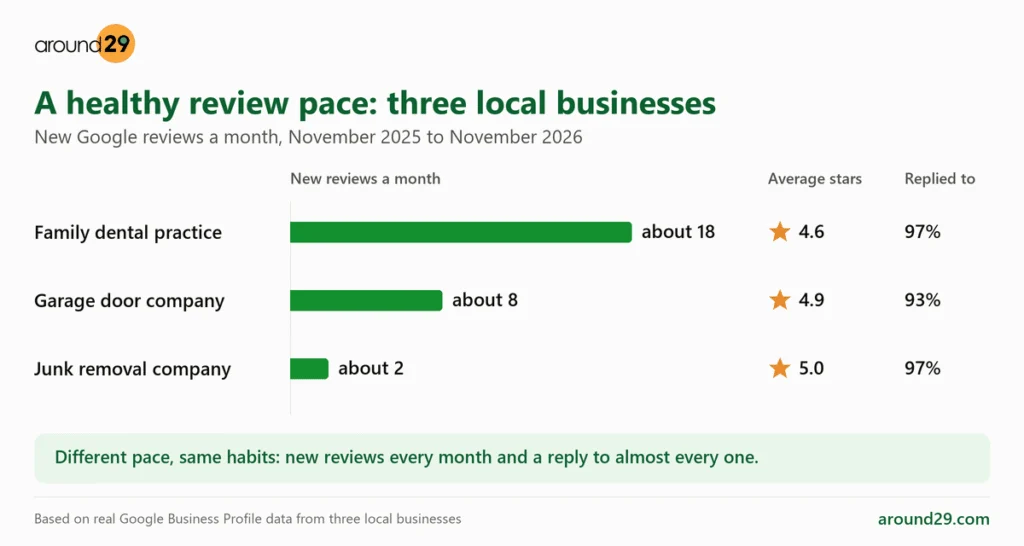
Here’s what the Google Business Profiles of three local businesses Around29 Digital Media Solutions works with looked like from November 2025 to November 2026:
| Local business | New Google reviews a month (about) | Average stars | Reviews replied to |
|---|---|---|---|
| Family dental practice | 18 | 4.6 | 97% |
| Garage door company | 8 | 4.9 | 93% |
| Junk removal company | 2 | 5.0 | 97% |
The average stars are calculated from the reviews in our reporting tool, so they can differ slightly from the rating Google displays.
None of these numbers is “right” on its own. Your pace should follow your customer count: the more customers you serve each month, the more people you can ask. What the three have in common matters more: new reviews keep arriving, the ratings stay high and the owners reply to almost every one. That’s the pattern customers trust, and it’s the pattern to copy.
Does your star rating matter more than your review count?
Both matter, but rating is the first filter: 31% of consumers will only use a business rated 4.5 stars or higher. Count and recency then tell people whether that rating is believable.
Picture a 4.8 from 12 reviews next to a 4.6 from 300. The first could be a handful of loyal regulars. The second reflects hundreds of customers. That’s why the goal isn’t a perfect score. It’s a high score backed by enough recent reviews to be convincing.
When a bad review lands, reply calmly, thank them, say what you’ll do about it and take the details offline. Google’s own advice is to reply to reviews and share your perspective, according to Google’s tips for getting more reviews. A calm reply to a 2-star review shows every future customer how you handle a problem.
How do you reach your review target without breaking the rules?
Ask every customer, make it one tap with your Google review link or QR code, and reply to what they write. Never pay for reviews, offer discounts for them or only ask the customers you think are happy.
What works
- Ask at the right moment. Right after a job is finished or a visit goes well, while the experience is fresh.
- Make it one tap. Google lets you create a review link or QR code that takes customers straight to your review form. Put it in your follow-up text, email, invoice and on a card at the counter.
- Ask everyone. Make it part of every job, not something you remember once a month. One person should own it.
- Reply to every review. It shows future customers someone is listening, and it’s the one review factor you fully control.
For the full routine, including how to reply to reviews, see the review section of the Google Business Profile optimization checklist from Around29 Digital Media Solutions. If you’d rather hand review monitoring and replies to someone else, Around29 also offers listings and reputation management.
What Google’s review policy bans in 2026
Google’s Maps content policy is clear on the big ones. Businesses must not offer incentives such as payment, discounts or free services for reviews. They must not “discourage or prohibit negative reviews, or selectively solicit positive reviews”, which rules out the common trick of texting a survey first and only sending happy customers to Google. Reviews based on a conflict of interest, including from current or former employees, aren’t allowed either, and neither is asking staff to collect a set number of reviews or to get reviews that name a staff member.
Google enforces this at scale. In its latest annual Maps safety report, Google said it blocked or removed more than 292 million policy-violating reviews and took down more than 13 million fake Business Profiles, according to Search Engine Roundtable’s coverage of Google’s Maps safety report.
It’s federal law too. The FTC’s rule on consumer reviews, in effect since October 21, 2024, bans buying or selling fake reviews (including AI-written ones), using insider reviews without disclosing the connection, and suppressing negative reviews, and it lets the FTC seek civil penalties, according to a Wilson Sonsini summary of the FTC rule. A cheap batch of fake reviews isn’t worth losing your real ones over, or worse.
Do Google reviews help you show up in AI search?
Yes, indirectly. AI tools lean heavily on Google Business Profiles when they recommend local businesses, and your reviews live on that profile.
BrightLocal’s study of 200,085 local AI searches across ChatGPT, Google AI Mode and AI Overviews found Google Business Profiles made up 28.5% of all the sources those tools cited. And people increasingly ask AI tools first: 45% of consumers now use ChatGPT and other generative AI tools for local recommendations, up from 6% a year earlier, according to BrightLocal’s 2026 survey.
Reviews also give AI tools words to work with. A review that says “they fixed our garage door spring the same afternoon in Lakewood” tells both customers and AI exactly what you do and where. Around29 Digital Media Solutions’ guide on how to get ChatGPT to recommend your business covers the rest of that picture, and if you want reviews showing up beyond Google, our Bing Places for Business guide is a quick next step.
What else do owners ask about Google reviews?
Here are short answers to common questions about how many Google reviews a business needs.
What is the minimum number of Google reviews a business needs?
Google doesn’t set one. For customers, 20 is a sensible first goal: 47% won’t use a business with fewer than 20 reviews, and only 9% will use one with five or fewer, according to BrightLocal’s 2026 survey.
How many Google reviews do you need to rank in the local pack?
There’s no fixed number. Google ranks local results mainly on relevance, distance and popularity, so compare yourself with the businesses already in the top three for your main search and aim to match or beat their review count.
How many new Google reviews should I get each month?
Enough that you always have reviews from the last few weeks. 32% of consumers look for reviews written in the last two weeks, so a steady monthly pace matters more than one big push.
Can I offer a discount for a Google review?
No. Google says offering incentives, like free or discounted goods or services, in exchange for reviews is considered fake and misleading content and is strictly prohibited.
Should I reply to every Google review?
Yes, good and bad. Google recommends replying to reviews, and 37% of consumers say an owner’s response is one of the most important things they look for in a review.
Want a quick check before you ask for more reviews?
Around29 Digital Media Solutions’ free Business Info Check confirms your website shows a correct, consistent name, address and phone number, the same details customers see on your Google Business Profile. It takes about a minute for businesses across Tacoma, Puyallup and Pierce County. Get a free local SEO and Business Profile check.